Case study 3 min read
SEO for a car dealership: +44.5% clicks with 6 pages
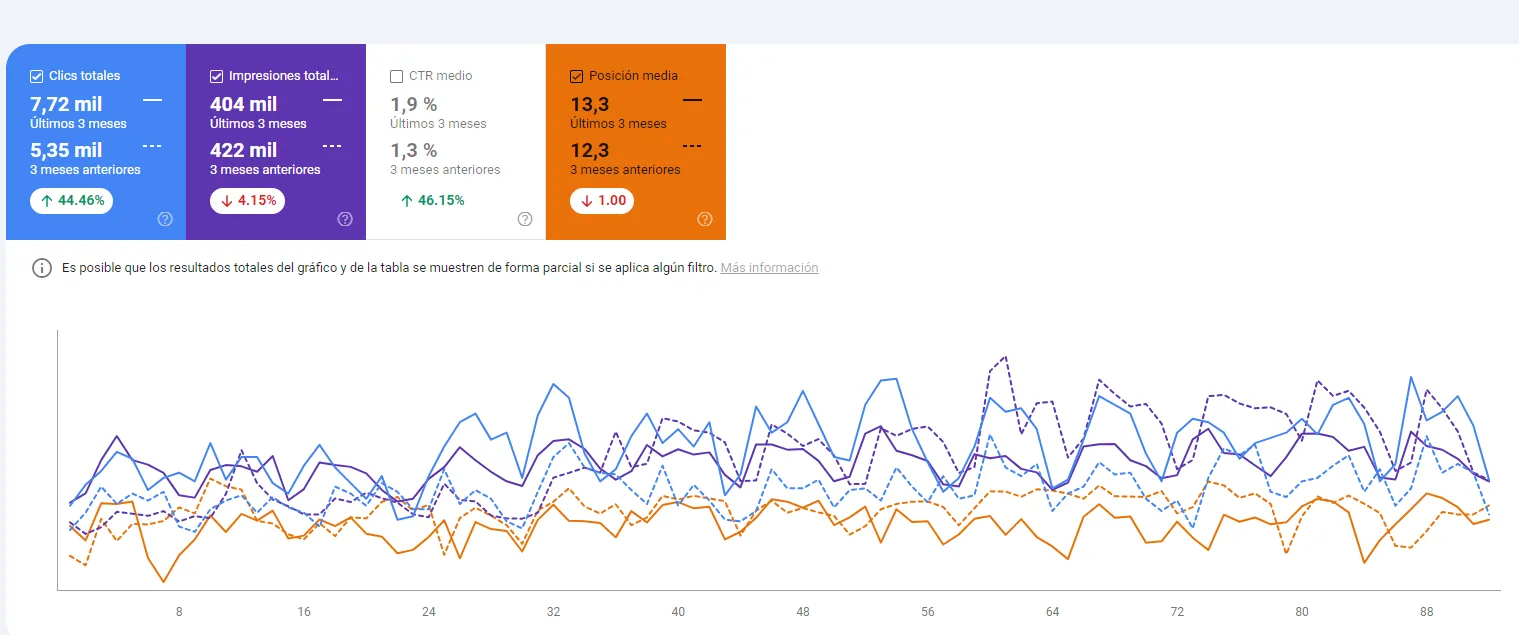
I created 6 pages by model and city and removed the ones getting in the way. In three months, an official dealership went from 5,350 to 7,720 clicks from Google.

Services used:
- Sector
- Automotive · official brand dealership in several cities
- Project
- Pages by model and city, and clean-up of the ones adding nothing
- +44.5%clicks from Google in three months (from 5,350 to 7,720)
- +46%more people clicking through when they see it on Google (from 1.3 to 1.9 in every 100)
- 6new pages, and nothing more
The starting point: lots of pages and none for the person about to buy
Someone buying a car doesn’t browse the website: they search for a specific model in a specific city. If that page doesn’t exist, the sale goes to another dealership.
That’s what was happening to this official dealership. It had a website, with loads of pages, but when someone in its city searched for the model it sold, it didn’t appear anywhere.
The reason is one almost nobody explains to you. Google doesn’t read your whole website every day: it gives it a limited amount of time. If that time goes on filters, duplicates and old pages, it’s taken away from the ones that could bring you a customer.
On top of that, there wasn’t a single page designed for someone about to buy. A generic catalogue doesn’t answer «model + city», and a buyer who already knows what they want lands wherever gives them an exact answer.
What I did
Reviewing the whole website
I crawled every page and split them into three groups: the ones that can sell a car, the ones that help and the ones that just take up space. Until then nobody had put numbers on how many there were of each kind.
Removing what got in the way
I removed or merged the pages that added nothing. Not for the sake of tidying up: each one was stealing Google’s attention from the pages that could bring in a buyer.
Creating the pages by model and city
I created six pages, one for each combination of model and city that people really search for. Each one answers a specific search, even if that means giving up on looking pretty.
Rewriting what shows up on Google
The title and description shown on Google are the only thing the buyer reads before deciding whether to click on your website or the one next to it. I rewrote them one by one so they said exactly what that person was looking for.
Measuring page by page
I tracked each of the six pages separately. That way you can say what produced the improvement, instead of taking credit because the whole website happened to have a good quarter.
What we achieved
In three months, the searches for its brand went from bringing 5,350 clicks to 7,720: 44.5% more people coming in to look at cars.
The most telling figure is another one. Out of every 100 people who saw it on Google, 1.3 used to click through; afterwards, 1.9. That’s 46% more people choosing its website rather than the dealership next door, without changing a single word on the pages it already had.
All of that came from six pages.
What we both gained
What the client gained
More buyers visiting its website at the moment of decision, without publishing dozens of pages or spending more on ads. And a cleaner website, where Google knows which page is for what.
What I took away
When a website doesn’t bring customers, the reflex is to publish more. Here the opposite happened: six pages were published and many more removed, and it worked because the problem was never volume, but that Google didn’t know which page was for what.
If your website is a few years old, it’s very likely carrying pages you don’t even remember that today are hiding the ones that could sell for you. In the car trade it happens even more, because catalogues generate addresses by the dozen without anyone checking them.
- I tell you which pages bring the customers. If I measure the whole website and traffic goes up, neither of us knows whether it was my work or Google having a good month. Page by page, I either prove it or I don’t.
- I don’t sell volume of content. Six well-thought-out pages moved more than dozens of generic ones, and cost you less.
- Removing is work too. Nobody boasts about deleting pages, but here it was half the result.
- The line Google shows about you matters a lot. It’s the only thing your customer sees before deciding whether to click, and rewriting it lifted the number of people clicking through by 46%.