Case study 3 min read
SEO migration for a B2B2C business: from 7 business enquiries a week to 7 a day
How I migrated the website of a national B2B2C business by separating companies and consumers: from 7 business enquiries a week to 7 a day in 6 months.

Services used:
- Sector
- National B2B2C business (sells to companies and to consumers)
- Project
- Website migration and new architecture for companies and consumers
- +900%business enquiries per day
- –70%visits that were never going to become customers
- 6 monthssince the migration
The starting point: two different customers on the same website
When I started analysing the website I saw something nobody had put a name to yet. Two completely different kinds of visitor were arriving: companies that hire its services and consumers looking for one-off information.
The website treated them the same. The same menus, the same links and the same navigation for two people looking for opposite things.
The result was what you’d expect. The pages for companies ranked for consumer searches, and the sales team lost hours filtering enquiries that had nothing to do with their business.
Google didn’t understand it either. And when Google doesn’t know who a page is for, it stops showing it to the people who really matter.
What I did
Understanding the business before touching anything
First I took time to understand how the company worked: what services it had, how the business customer differed from the consumer, and what the team considered a good enquiry. Without this, any new structure would have repeated the same mistake.
Seeing what each one was searching for
With Search Console and Semrush I looked at which searches brought real visits and whether each page answered what it was supposed to. Many business pages ranked for consumer searches and vice versa: the problem was the structure, not the copy.
Auditing the website before migrating
With Screaming Frog and Search Console I mapped the whole website: crawl errors, misplaced canonicals and redirects. Reviewing everything before moving anything is what prevents losing rankings during the migration.
Two keyword lists and a new structure
I did two separate keyword studies, one for companies and one for consumers. From that came which pages had to exist, which to create and which to merge or remove.
Then I designed a structure that separated the two worlds: menus, internal links and titles designed so each person knew from the first click whether they were in the right place.
Explaining the risks before starting
I presented the full plan: what we’d do, in what order, what depended on development and what could lower traffic for a few weeks. The client approved it knowing the risks.
Working with the development team
The website was hand-built in WordPress with custom fields, and it was implemented by an external team who inherited it. That delayed the project by 3 to 4 months on the original timeline.
Measuring after the migration
Once the migration settled, I presented the results with data from Search Console, GA4 and Looker Studio: how much the traffic that mattered grew, how much the traffic that didn’t fell, and how many business enquiries were arriving.
What we achieved
Business enquiries went from 7 a week to 7 a day, without touching the advertising budget or launching new campaigns.
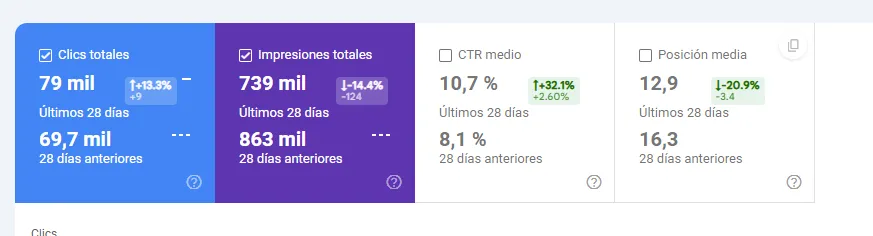
I can’t show the CRM data for client privacy reasons. What I can show is Search Console: 79,000 clicks and a CTR (the percentage of people who click through when they see you on Google) 32.1% higher in the 28 days after the migration.
Impressions fell by 14.4%, and that’s exactly what should happen when you stop appearing in searches you don’t care about: fewer people who weren’t going to hire, and more clicks from those who were.
What we both gained
What the client gained
A channel that brings in companies that hire, not consumers asking questions. Its sales team stopped losing hours filtering enquiries and started dealing with contacts they genuinely care about.
What I took away
A website’s structure is communication too. If the person doesn’t understand where they are and who that page is for, technical SEO is no use. The structure has to make sense to a person before it makes sense to Google.
The goal is customers, not visits. Cutting the visits that didn’t matter by 70% while enquiries multiplied tenfold is a success, not a failure.
Companies and consumers are two websites inside one. Separating them affects every page, every menu and every link. Mixing them has a real cost in enquiries.
Raising problems in time strengthens the relationship. With inherited code there are always delays, and you have to flag them before starting. Telling the client about a real problem doesn’t weaken trust; what weakens it is them finding out on their own.